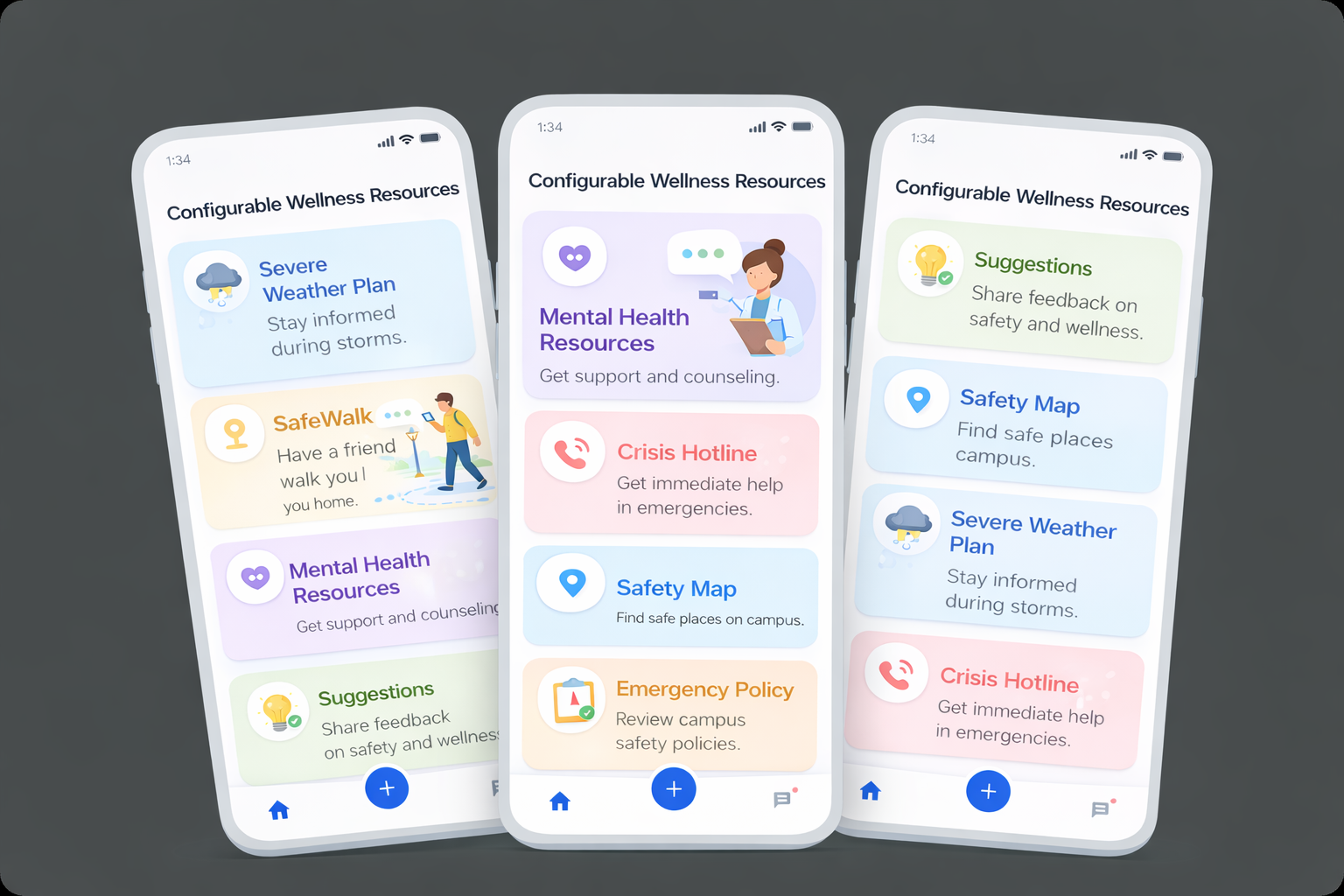
Student safety apps play an increasingly important role in modern campus environments by giving individuals direct access to tools that support their personal safety in real time. While campus security teams provide critical coverage, students often navigate spaces independently, especially during evenings, travel between buildings, or off-campus activities.
Personal safety features such as SafeWalk offer a practical and accessible solution. This tool allows students to share their journey with trusted contacts who can monitor their progress in real time. Whether walking across campus late at night or traveling in an unfamiliar area, students can feel more secure knowing someone is virtually accompanying them.
What makes this feature effective is the level of control it gives users. Students can choose who they want to share their location with and decide whether those contacts follow their progress live or simply receive a notification upon arrival. This flexibility makes the tool adaptable to a wide range of situations, from short walks across campus to longer commutes.
In addition to passive monitoring, SafeWalk includes built-in emergency options. If a student feels unsafe at any point during their journey, they can quickly access emergency services or connect with campus security directly from within the app.
At a practical level, students use these tools in moments like:
- Walking alone at night between residence halls and parking areas
- Traveling across campus during low-traffic hours or breaks
- Navigating unfamiliar areas during events or campus visits
- Commuting to off-campus housing, internships, or transit stops
This ensures that help is always within reach, even in moments of uncertainty. This ensures that help is always within reach, even in moments of uncertainty.
For student life administrators, promoting personal safety tools like this supports broader campus safety initiatives without requiring additional physical infrastructure. It extends the reach of campus safety beyond fixed locations and into the everyday experiences of students.
These tools also contribute to a stronger sense of confidence among students. When individuals feel that they have immediate access to safety resources, they are more likely to participate in campus activities, attend evening events, and engage more fully in student life.
Another important benefit is the ability to support a culture of shared responsibility. Safety becomes a collective effort, where students look out for one another and actively use available tools to reduce risk. This aligns closely with student life goals around community building and peer support.
Student safety apps are not limited to walking scenarios. They can be used during travel, late-night study sessions, commuting to internships, or navigating unfamiliar environments. This flexibility makes them relevant across a wide range of student experiences. One of the most widely used features is SafeDrive, which lets users share their journey in a way similar to SafeWalk, only across greater distances.
From an operational perspective, these tools complement existing safety systems by reducing reliance on reactive measures alone. Instead of waiting for incidents to occur, students are equipped with proactive tools that help prevent situations from escalating.
For student life teams, the impact is both practical and cultural. Students feel safer and more supported, while administrators gain confidence that safety resources are accessible beyond traditional campus boundaries.
Ultimately, student safety apps empower individuals while reinforcing institutional safety efforts. They provide a simple but powerful way to enhance personal safety, strengthen community awareness, and create a more supportive campus environment.
Put safety directly in your students’ hands.
See how Lightspeed empowers your campus community with real-time tools for everyday safety and peace of mind.
Request a demo
